

Islam in Europe: Wooden Prayer Spaces of Ottoman Thrace (Bulgaria and Greece) – Testimony to a Spiritual Continuum
Of particular relevance here is the interior dome of the Paşayazi Köyü Camii: it is lined with plain wooden radial segments and others made up of small polygonal pieces applied in a chevron pattern similar to those forming the entire ceiling decoration in the Didymoticho mosque.
Although all these cupolae are later in date than that currently attributed to the ceiling of the Didymoticho mosque, there appears to be an historical connection, the dynamics of which are still to be determined. Where they inspired by it? The city was a centre of the Bektashi tarikat, a Sufi order which played a prominent role across the entire zone under discussion from the time of the Ottoman’s conquest of the south-east Balkans.
In Ottoman Thrace, mosque structures employing timber as well as stone or brick became quite common, wood being mainly used in entrance porticoes and inner mezzanine galleries for women worshippers. A small mosque (the Eski Jamiya) in this tradition in Haskovo, 78 km south-east of Plovdiv, is said to be the oldest mosque in the Balkans.
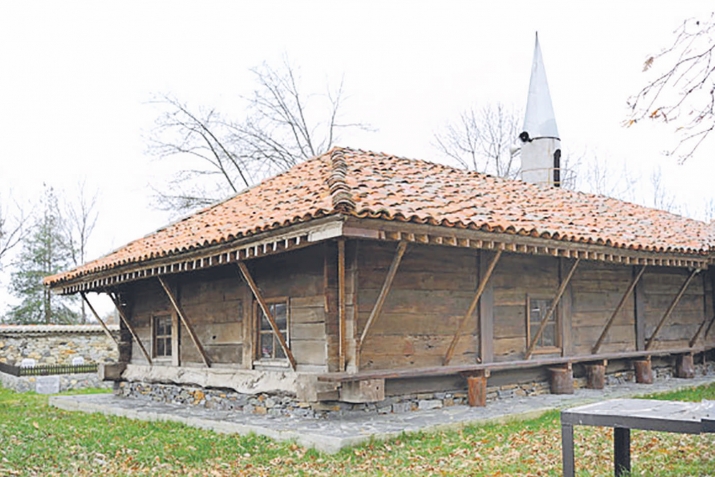
Noteworthy also is a vernacular mosque in the village of Chal in the central–eastern Rhodope of Bulgaria. Known as the Ahat Buba Dzhamisi (the Mosque of Ahat Buba), it is the oldest dated mosque in the eastern Rhodope (1786-87). While its walls are of stone, it has an ornate wooden columned interior, and porch and roof support structure of wood. For those familiar with the two-storied popular wooden mosques of the far north east of Turkey and Adjara, its proportions, dimensions, interior structure, roof and window disposition are strikingly alike (there are wooden mosques in the Trabzon region which also have substantial masonry components).

The builders of the three prayer spaces described above used wood in diverse ways to create environments which would nurture worship and express love for the Almighty. All have characteristics which clearly link them to popular traditions of mosque building which developed further to the east along the Black Sea coast and hinterlands.
The unity of custom and belief manifested in these creations of Muslim communities and their craftsmen across so many centuries and such a broad geographical expanse is testimony to the spiritual continuum of the Islamic faith throughout the Ottoman period – which continues to inspire the Muslims of Greece and Bulgaria today.
The area explored by F.R. Maunsell remains largely unvisited by outsiders: the words of a modern visitor to the Bulgarian Rhodope provide an update - while also recalling in many respects Maunsell’s observations of more than a century ago:
“In the western part of the Rhodope range, villages are thin on the ground – but eastwards I found myself in more thickly settled country, where rolling hills are dotted with hundreds of tiny villages. Many seemed half-deserted. Others are no more than ghost towns. In the shadow of small village mosques many older men chatted and drunk coffee. In many places, there was little sign of younger people. Most, I learnt, had left for Bulgaria’s big cities, or for Turkey, where job opportunities beckoned. This part of the world is well off the beaten track. The few current guidebooks to Bulgaria hardly mention it. Although unaccustomed to foreigners, villagers welcome strangers. Most of the 6,000 inhabitants of Madan, a thriving district capital, are Bulgarian Muslims. Its well-kept mosques are in sharp contrast to the somewhat dilapidated village mosques elsewhere. It’s a pleasant, green little place, surrounded by pine-covered hills. This rugged territory, bridging Turkey and Greece, is Bulgaria’s Muslim heartland - around 15% of Bulgaria’s seven million people are Muslims – the highest proportion of any European country.
Guy (Ghaydar) Petherbridge
Professor, Expert on cultural heritage and history of Islam, Australia, Russia