

Muslim coins of the Bukharkhudat type
Muslim coins of the Bukharkhudat type
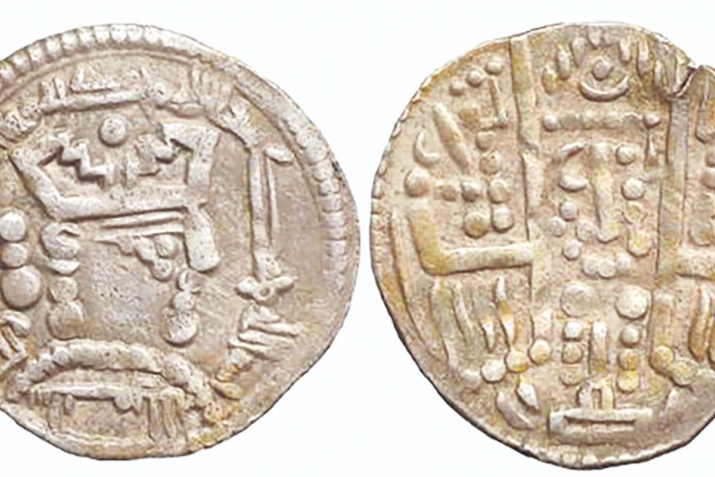
On the territory of modern states: Uzbekistan, Tajikistan and in the southern regions of Kazakhstan, there have been found amazing Muslim coins that have received the scientific name “Bukharkhudat type dirhams”.
The history of Bukharkhudat type coins dates back more than two centuries of active monetary circulation and regular abundant minting. The name of the coins comes from the local name of the rulers of Bukhara – Bukharkhudatov.
At the end of the sixth century, taking the drachma of the Sasanian Shahinshah Varahran V as a model, silver coins began to be minted in Sogdian Bukhara. The silver drachma served the markets of Sogd – Bukhara, Samarkand and the territories adjacent to these cities. On the obverse of the coin there is a schematically designed drawing of the ruler’s profile, turned to the right and wearing a traditional headdress – kulakh. Around the profile, along the edge of the coin, there is a circular inscription in the Sogdian alphabet in the Sogdian language that says that the coin was minted by the “lord of Bukhara.”
The reverse also schematically shows an Avestan religious scene. A flaming altar guarded by two priests – mobeds.
During the first century of Arab rule, such coins continued to be in circulation without any changes. Only the name was changed. The coin became known as a dirham and was simultaneously used with the dirhams of the Umayyad and then Abbasid caliphs.
The second transformation of the coin occurred during the reign of the Abbasid caliph al-Mansur, who appointed his son al-Mahdi (775–785). as the governor of the province of Khorasan, which included Mawarannahr (literally from Arabic “territory beyond the river”, the medieval name for the regions along the right bank of the Amu Darya River, now the territory of most of Uzbekistan and the west Tajikistan). Under him, one word was added to the Sogdian legend, written in the Arabic alphabet, in Kufic script – al-Mahdi. The word occurs in an old Sogdian legend and is located right behind the portrait’s head.
Coins with other Arabic names were less common – Khalid, Muhammad, Ali. These are probably also the names of governors.
The last transformation of the legend on Bukharkhudat type coins occurred at the final period of their being minted. The coin had a lengthy Arabic inscription “There is no god but Allah, and Muhammad, peace and blessings be upon him, is His Prophet,” written in Kufic script around the same portrait of the ruler.
Coins of the Bukharkhudat type had special features.
They were not exported outside of Mawarannahr, that is, the area of circulation was strictly limited to Central Asia. While, Kufic dirhams continue to be found today in treasures throughout Eastern Europe, coins of the Bukharkhudat type are found only in treasures found in the south of Central Asia.
It was in these coins that all taxes were calculated and paid. It was impossible to pay taxes with other coins, especially after the start of minting dirhams from copper coated with a thin layer of silver. After this, Bukharkhudat type coins became indispensable. Kufic dirhams, minted at the same time from high-grade silver in Samarkand, Bukhara and Al-Shash (Tashkent), although highly valued in Eastern Europe, were not accepted for payment of taxes to the caliph and local rulers. Merchants who had high-grade silver dirhams had to exchange them for copper dirhams of the Bukharkhudat type at a forced rate, that is, paying more for them than they were actually worth.
Historians do not know exactly when the minting of Bukharkhudat type coins ceased, but these dirhams continue to be found in treasures dating back to the twelfth century CE.