

Twelve Forgotten Achievements of Muslim Scholars
Twelve Forgotten Achievements of Muslim Scholars
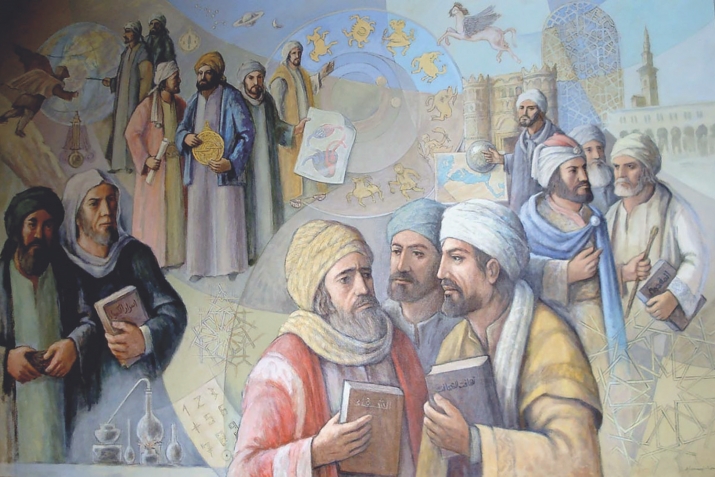
Today, it is common to associate scientific and technological advances with European civilisation. However, few people know that without the scientific advances of the Muslim world in the Middle Ages, modern European civilisation would never have reached the heights of science it has. We will attempt to fill this gap a little and present to our readers the most significant achievements of Muslim scholars.
- “Al-Qanun fil-Tib” – a work on medicine by the outstanding scholar Ibn Sina (980-1037). Perhaps no other ancient scholar and healer had such a profound influence on the science of healing. 500 years later, his works were studied and cited by Leonardo da Vinci and other luminaries of science. “Al-Qanun” was used at the University of Brussels until 1909.
- “At-Tasfir Liman Ajiza Anit-Talif” is another outstanding work devoted to surgery, medicine, ophthalmology, orthopedics, pharmacology, dentistry, nutrition and more. The author was Abul-Qasim Khalaf ibn Abbas az-Zahrawi, or Albucasis (936-1013). He was the first surgeon to introduce catgut (sheep intestine) sutures into everyday practice. His inventions include a number of complex surgical instruments, including scalpels, syringes, forceps and surgical needles.
- “Tadhkirah”, a book written by Ali ibn Isa (11th century), contains descriptions of 130 eye diseases. This work remained the most authoritative publication on ophthalmology for centuries, until approximately the mid-19th century.
- “Kitab al-Malikii” is a medical encyclopedia by Ali ibn Abbas (d. 994), who performed oncological surgeries. His book remains relevant today.
- “Pharmacognosy in Medicine” is a book on medicinal preparations by another prominent scholar of the Muslim world, al-Biruni (973-1048). This is a major work that remains highly relevant today. In this book, he described in detail approximately 880 plants, their individual parts and secretions, provided their precise characteristics and codified terminology. Al-Biruni collected and explained approximately 4,500 Arabic, Greek, Syrian, Indian, Persian, Khwarezmian, Sogdian, Turkic and other plant names; these synonyms are important for modern research into the history of pharmacognosy.
- “Al-Kitab al-Mukhtasar fi Hisab al-Jabr wa-l-Muqabala” (The Brief Book of Completion and Contrast) is a mathematical treatise by al-Khwarizmi (780-850), a prominent mathematician, astronomer, geographer and historian. The term “algebra” derives from the title of this treatise. This work is an important milestone in the development of arithmetic and classical algebra, the science of solving equations. Al-Khwarizmi first presented algebra as an independent science of general methods for solving linear and quadratic equations and provided a classification of these equations.
- “The Book of Indian Counting”, authored by al-Khwarizmi, contributed to the popularisation of Arabic numerals and the decimal positional system of number notation.
- “Kitab Surat al-Ard” (Book of the Picture of the Earth), the first work on mathematical geography, had a strong influence on the development of this science. It defined latitude and longitude. It is also by al-Khwarizmi.
- “Sabaean Zij” (The Book of the Picture of the Earth) is a work by the eminent astronomer and mathematician al-Battani (858-929). This work was translated into Latin by Plato of Tivoli in 1116. It greatly influenced European astronomy, including Georg Purbach, Regiomontanus, and Nicolaus Copernicus. Al-Battani also calculated the solar year and his data almost completely coincide with modern ones (with an error of only 24 seconds). It is worth noting that this Muslim scholar’s trigonometric table is still used today.
- “Kitab al-Haraqat al-Samawiyya wa Jawami ‘ilm al-Nujum” (The Book of Celestial Motions and the Compendium of the Science of the Stars), by al-Farghani (850-895), was translated into Latin and had a profound influence on the development of Western astronomy for 700 years. He scientifically proved that the Earth is a sphere and also established that the sun has spots.
- “The Book of Optics” is a fundamental work on optics by Ibn al-Haytham (965-1039), a mathematician, mechanician, physicist, and astronomer known in Europe as Alhazen (al-Khazin). This book had a profound influence on the development of optics worldwide. This Muslim scholar described the structure of the eye and provided a correct understanding of binocular vision. He proposed the finite speed of light and conducted experiments with a camera obscura (the precursor to modern cameras), light refraction and various types of mirrors. The mechanism of light reflection in spherical mirrors is named after him – “al-Khazin’s problem”.
- “Kitab al-Khiyal” (The Book of Dreams) is a book that laid the foundations of cybernetics. Its author, Abul-Izz Ismail al-Jazari (d. 1206), invented the crankshaft and designed valve pumps, water-lifting machines, water clocks, musical automata, and more. Al-Jazari is credited with such technological innovations as wood lamination, combination locks, a hybrid compass with a universal sundial for all latitudes and more.