

World breakthrough of the year in physics
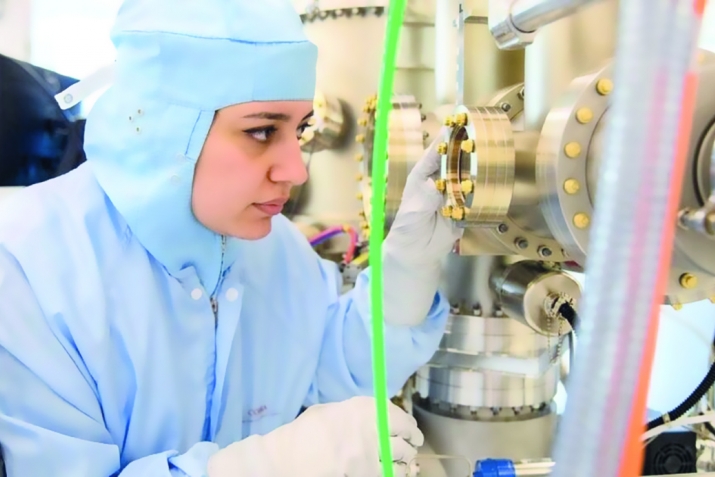
Muslim scientist Elham Fadaly and her team at Eindhoven University of Technology in the Netherlands have achieved the World Breakthrough of the Year award for their silicon-based material with a direct band gap that emits light at wavelengths used for optical telecommunications.
Elham Fadaly, PhD student at the Department of Applied Physics, received the award along with Alain Dijkstra and Erik Bakkers. Their work is the result of interaction with Jens Rene Suckert of Jena University named after Friedrich Schiller in Germany as well as with an international team of employees.
According to Physics World, the new siliconbased material can be used not only in optical telecommunications and optical computing, but to create chemical sensors as well.
“Silicon devices run our information society, but the material’s indirect band gap [an inherent property of the atomic structure that prevents light from emitting] holds it back when it comes to telecommunications and other advanced optical applications,” said Hamish Johnston, jury member and editor of Physics World.
“By creating a siliconbased material that emits light at telecommunication wavelengths, Bakkers’ team opened the door to a whole new world of applications for silicon devices.”
Physics World is a publication of the famous Institute of Physics in Great Britain. It has honored international scientists with the ‘Breakthrough of the Year’ every year since 2009. It is awarded to those scientists who have done some groundbreaking inventions in the field of theoretical and experimental researches.
Elham Fadaly was born and raised in Egypt. She studied Bachelor of Science in electronics engineering at the American University in Cairo, the capital of Egypt. During the study she was fascinated by nanotechnology and how wide and progressive the field of its practical application is in our daily life.
Therefore, Fadaly decided to continue her work, and to contribute to this little-known branch of technology, gained a master’s degree in nanoscience and nanotechnology with a specialization in nanoelectronics from the Catholic University of Leuven (Belgium) and the Chalmers University of Technology in Sweden.
Currently, she is pursuing a PhD at Eindhoven University of Technology in the Netherlands. Her doctoral research is focused on the production of nanomaterials for a wide variety of applications and the study of their optical and electronic properties.
This award is not the first for Fadaly. In 2020 she also received an award from the Kijk tech magazine in the category “Best Technology”.
SAIDA IBRAGIMOVA