

Hajar - the mother of Prophet Ismail
Hajar - the mother of Prophet Ismail
The story of the noble Hajar is connected with Lady Sarah.
The Prophet Ibrahim (Abraham) and Sarah had been married for many years but they had no children. Being already in old age, the wife of the Prophet of God Ibrahim was worried and saddened by this.
Soon, a girl Hajar appeared in their lives - a servant, given to her by the Pharaoh of Egypt. Seeing the beauty and chastity of the servant, Sarah decided to give her to Ibrahim, so that she would bear him an heir. They got married and soon the long-awaited first child, Ismail, was born.
However, after the birth of her son, Hajar felt more confident and proud. Being the eldest, Sarah could not stand her bickering. The situation was aggravated by the jealousy that existed between the two women and increased with the birth of Ismail.
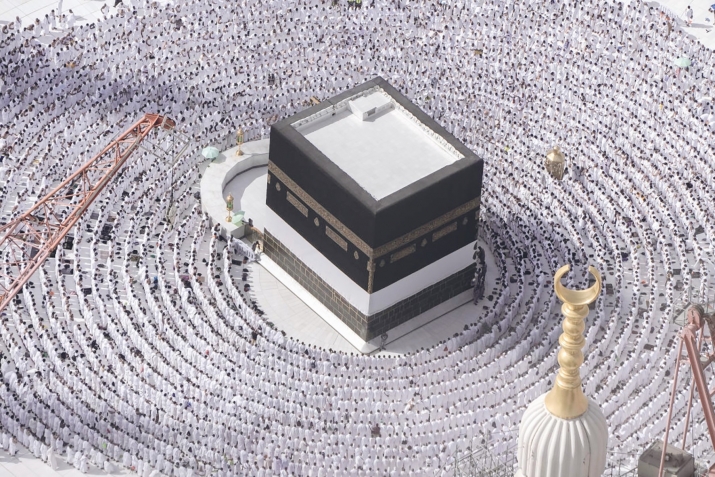
However, in the future, the relationship between the women only worsened, and Sarah said that she did not want to see Hajar anymore. After some time, the prophet Ibrahim received a revelation. By the will of the Lord, he saddled a camel, took the necessary provisions with him and set off on a journey with Hajar and their baby. Thus they reached the sacred lands, where the venerable Mecca is located in our time.
The prophet Ibrahim left them in a secluded place. Hajar asked her husband why he was leaving them alone. “Has Allah ﷻ commanded you to do this?” she asked. “Yes,” answered Ibrahim. “Then we will not be lost,” answered the noble woman.
Trusting in the Almighty Lord, Ibrahim recited the following prayer, which is an ayah of the Koran (meaning of the commentary), “Our Lord! I have settled a part of the offspring in a [barren] valley where there is no grain [where useful plants cannot be grown], by Your sacred House [the Kaaba]. Our Lord! Let them [fully] perform the prayer. Fill the hearts of the people with love for them [for my family, whom I settled in Mecca, and for their offspring] and provide them with [various] fruits, that they may be grateful.” (Sura “Ibrahim”, ayah 37).
Left alone, Hajar and the baby lived for some time on the provisions they had. But they soon ran out and the mother thought about finding food. Since the area was infertile and there was no source of water nearby, she climbed the nearest hill of Safa. With hope, Hajar listened and tried to discern some source or people in the distance. Then she climbed the hill of Marwa, asking the Almighty for help. Thus, seven times, she covered the distance between these two hills.
Ibn Abbas narrated about this from the Messenger of Allah ﷺ, “For this reason, people make a walk (sa’yu) between them during the pilgrimage.”
Having climbed the hill once again, Hajar heard a strange sound. “Be silent!” she said to herself. “What you heard may be help for you.”
She listened and turned her gaze to the side where she had left her son. Near the baby there was an angel who struck the ground with his heel and water miraculously began to flow out of it. Hajar began to scoop it up, filling the vessels, and the spring continued to bubble. “Zam-zam, ya mubarak!” (“Stop, stop, O blessed one!”), she said, and only then did the stream calm down. Hajar fed the child and gave him some blessed water to drink. The angel said to her, “You will not be lost! Indeed, this child and his father will build a house of Allah ﷻ here. The Almighty will not let its (the sacred area) inhabitants be lost.” And so it happened by the will of the Almighty Creator.
After some time, people from the Jurhum tribe, heading to Sham (now the territory of Syria and neighboring states), saw birds over a mountain. “Indeed, these birds indicate water,” they said. “Do you know where there is water in this area?” they asked each other but no one knew. When they approached, they saw a woman with a child and asked permission to stay near them. The mother of Ismail allowed them to stay, but on the condition that they would not have the right to own the water. To which they readily agreed.
The years passed. Ismail (may Allah be pleased with him) grew up hunting, which is why he would leave the protected area (haram) for a while and then return. Hajar did not live long - she died before her grandchildren were born. She left this world happy with her fate. May Allah be pleased with her! Amen.
Madina Zakarzhaeva
As-Salam writer