

History of sufism in Dagestan
Sufism has an age-old history which has only recently become the subject of study. However the last few years have seen a certain amount of work done in this regard, for example in the publication of important articles on the history and practice of Sufism in Dagestan, especially of Sufi treatises by Dagestani authors of the 18th-20th centuries. The pool of research sources has grown, including the release by the Eastern Literature publishing house in Moscow of an important monograph by the Dagestani author Alikber Alikberov on the early history of Sufism in Dagestan.
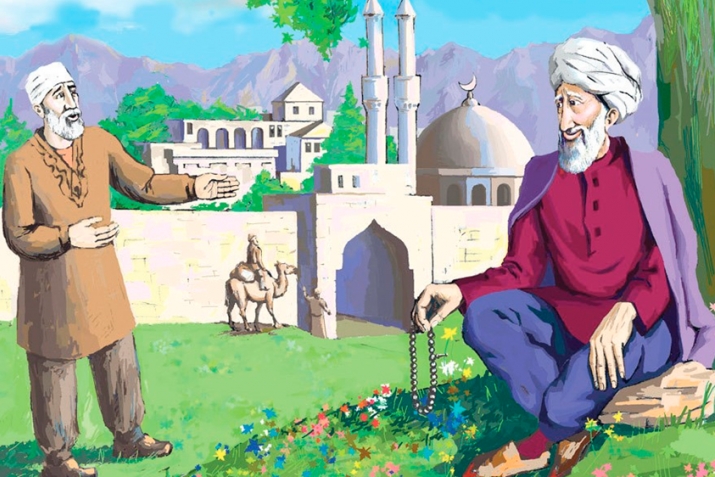
As is well-known, 1400 year old Islam has played a tremendous role in the spiritual, economic and political life of Dagestan across many stages of history. The environment in which Islam developed determined its special face and was conducive to the stability of this monotheistic religion as it spread among confessional pluralism.
Historical and cultural links between the Middle East (especially the Arab Caliphate) and Dagestan in the pre-Mongol period have so far not been thoroughly studied. Both recent discoveries and previously known materials allow us to glimpse into the history of spiritual communication between the peoples of Dagestan and many centres of Islamic culture.
Both political and economic factors actively promoted cultural communication. The partial inclusion of Dagestan in the Arab Caliphate and then in the Seljuk Empire triggered cultural development in all its regions and encouraged a wide dissemination of the cultural achievements of the epoch and the active formation of new ideological movements in Dagestan.
The history of Islam has several periods, each of them very particular. The classical Islamic era is one of the major historical stages. The period dates back to the introduction of the Muslim teachings at the beginning of 7th century and the formation of the Arab Caliphate until its fall in 1258 under the attacks of Mongol forces.
It was this period that became the subject of investigation by Alikber Alikberov. His study is based on the unique Arabic manuscript ‘Rayhan al- Haqaiq wa-Bustan al-Daqaiq’ (‘Basis of Truths and Garden of Subtleties’) – a Sufi encyclopedia written by a Sufi from Derbent, Abu Bakr Muhammad, the son of Musa al-Darbandi. Through numerous facts the monograph shows that Islam spread widely in the region – mainly as Sufism. In that historical context Sufism incorporated Muslim teachings and introduced them into the local environment. Sufism, which played a huge role in the Muslim world in the 10th-12th centuries, grew from elite ideas and movements to be the ‘confession of the masses’ according to researchers. Derbent of the 11th - second half of the 13th century was a Sufi city.
Sufism in Dagestan in the 11th - first half of the 13th centuries is extensively covered in ‘Epoch of Classical Islam in the Caucasus’. This publication highlights that later Sufism, i.e. in the second half of the 13th-17th centuries, has been poorly studied. Until recently there was not even talk about researching the subject primarily because of the absence of available sources. However, the gradual accumulated of new information has changed the attitude to the issue.
In spite of their scarcity, the monuments of epigraphy and narrative texts reveal the fairly strong position of Sufism in Dagestan at that time.
Sufism is generally regarded as a phenomenon of ‘urban culture’. Dagestan, however, provided a different context: the ‘demand’ for Sufi ideas emerged in rural areas, starting from the 12th century and becoming especially strong in the 15th-17th centuries. This is evidenced graphically by memorial texts on the tomb of Sheikh Ahmad ibn al-Husayn in Derbent (11th century) and on the graves of Sufi Sheikh in Tatil’ village (12th century), the construction of khanak – Sufi lodges - in Rutul (12th century), ‘pir’- sanctuaries in Akhty, Khnov, Rutul, Tpig, Mishlesh and Orta-Stal 15th-17th centuries), and the tomb of Sheikh Asildar in Arkas (15th century).
In 861/1456-57 Mahmood of Khinalug wrote a historical treatise on political events in the region. This work was based on the ‘reliable ascension line’ recorded in the presence of about two hundred people (from the villages of Ikhir, Kurush, Maza, Rutul and Kurakh) - they were all Sufis.
Recently, there have been discovered ziyarats of sheikhs in Sogratl dating back to the 12th century; including that of the Murshids’ Sheikh, ‘the Qutb of Qutbs’ (‘the Pole of Poles’) Sheikh Muhammad (village of Machada, 1634). Sheikh Muhammad, the son of Musa, is one of the most revered representatives of the Sufi hierarchy. He was recognized as a leading spiritual authority of his time. Sheikh Muhammad seems to have been of the Naqshbandi Tarikat.
There are many Sufi Tarikats. One of the most popular is the Naqshbandi Tarikat. As al-Kurdi notes in al-Mawahib as-Sarmadiya, the name of this Sufi brotherhood comes from the word ‘Naqshbandi’ (meaning ‘a pattern on the heart’) and is associated with the name of Bahauddin al-Bukhari (1318-1389), the most prominent figure in Central Asian Sufism.
The Tarikat became widespread outside Central Asia as well. The role of Sufism in Dagestan is illustrated in the ‘geography’ of existing copies of works written by an outstanding thinker of the Muslim world and Sufi ideologist al-Ghazali (1058- 1111). Manuscripts of his work were preserved in different Dagestan regions in public and private collections and in mosques. Al- Ghazali’s “Ihya ‘Ulum al-Din” (The Revival of the Islamic Sciences) had the most profound, intense, long- lasting and large-scale effect.
Dagestan possesses the earliest copies of this ethical-dogmatic treatise. The Foundation of Oriental Manuscripts at the Institute of History, Archaeology and Ethnography of the Dagestan Science Centre of the Russian Academy of Sciences in Makhachkala houses one of the oldest, if not the oldest, manuscript of “Ihya ‘Ulum al-Din”, consisting of two books (Kitab) of the fourth part (Rub), called Al-Mundzhiyat (The Saviors).
The first part was rewritten on 20 Dhu ‘l-Kada, 586/19 December, 1190 and the second on 7 Dhu ‘l-Hidja, 586/5 January, 1191, in a place clearly stated in the manuscript: “the City of the World, Baghdad”. All the surviving copies of “Ihya ‘Ulum al-Din” are in Dagestan: that made in 1495 in the village of Shira by Harun, son of Ahmad; in 1497 by the same Harun al-Shira; in 1505 in the village of Akusha by Idris, son of Ahmad al-Akusha; in 1510 by Idee, son of Muhammad al-Zirihgeran; in 1673 by Khidhir, son of Manat from the village of Mugi and in 1679 by Muhammad, son of Muhammat.
There are also 11 manuscripts of another great work by al-Ghazali, “Minhaj al-Abidin” (‘The Path of the Worshippers’). The earliest surviving copy was made by the above-mentioned Idris, son of Ahmad from Akusha, in 1497. A later copy of 1682 was made in the village of Gotsatl at the madrasa of “our Imam,the honorable Ustaz accomplished in sciences, Mala Muhammad the son of Umar from the village of Tsad”.
Foreign Muslim writers also provide some interesting information here. The Turkish traveler Evliya Celebi (17th century) who visited the North Caucasus twice (in 1641-42 and 1666-67) describes a fortress on the Koisu river, where there are three hamam, a tavern, and seven elementary schools, three madrasas, two tekkes of the Naqshbandi order of dervishes [Sufi adherents] and three inns for merchants. Sufis also lived in another village under the rule of the son of Karabudak Khan. The latter “in a secluded corner of the mansion indulged in prayers, studied history, the Hadith; from dusk till dawn he studied under the tutelage of Dagestan’s worthiest scholars”.
A monument to Sheikh Muhammad (died in 1634 or 1635) gains a special importance as a relic of the Nakshbandi brotherhood of the early 17th century.
One should mention another work by al-Ghazali, his legal treatise “Al-Wajiz” (The Short Commentary). This work was copied in 1310 in the Middle East in Caesarea, and was brought to Dagestan by the famous conqueror Amir Timur at the end of the 14th century who gave it to the head of the village of Mugi with instructions to abide by it fairly.
Finally, in Dagestan five manuscripts have been found of “Jawahir al-Qur’an” (The Jewels of the Koran), copied in the 17th century in the villages of Akusha, Karata, Mulebki and Uri.
We thus see that Dagestanis, especially in the 15th-17th centuries, were very interested in the works of al-Ghazali, one of the great theological scholars of the Middle Ages. His earliest existing manuscripts are traced back to the 12th – 14th centuries, to the cities of the Middle East, especially Baghdad. Afterwards, however, in the 15th-17th centuries, the flow of manuscripts from the Arab countries stopped and Dagestani believers started to make copies locally.
The location of the manuscript copying centres is of great interest. In the 15th century manuscript copying of books was concentrated mainly in the villages of Dargwa (Kubachi, Akusha and Shiri), but in the 16th- 17th centuries it spread to Avar, Lak and Tabasaran villages. However, texts of the 18th century have not yet been found. The reason for the waning of interest in al-Ghazali’s works has still to be understood.
The interest to al-Ghazali’s ideas in the 12th-17th centuries can be explained not only by the rule of the Shafi Madhhab in Dagestan and the adaptability of Sufism to local pre- Islamic cults, but also by fact that many Dagestanis went to study in the Caliphate, and mainly to Baghdad at al- Ghazali’s Madrasa al Nizamiyya.
State support for Sufism had a major impact on science and manuscript culture. Moreover, it long defined the scope and themes of manuscripts flowing into Dagestan and copied here by the local scribes (katib). Writings by al-Ghazali ranked rather high among them.
Sufi brotherhoods in Dagestan have shown, especially in recent years, their vitality, love for peace, and perseverance in the protection of the unity of Dagestan. This historical overview will help to better understand the role of Sufism in the spiritual and social life of Dagestani society nowadays.
AMRI SHIHSAIDOV, PROFESSOR, DOCTOR OF HISTORICAL SCIENCES, CHIEF RESEARCHER AT THE INSTITUTE OF HISTORY, ARCHAEOLOGY AND ETHNOGRAPHY OF THE DAGESTAN SCIENCE CENTER OF THE RUSSIAN ACADEMY OF SCIENCES, HONOURED SCIENCE WORKER OF THE RUSSIAN FEDERATION AND THE REPUBLIC OF DAGESTAN