

Annual Pilgrimage
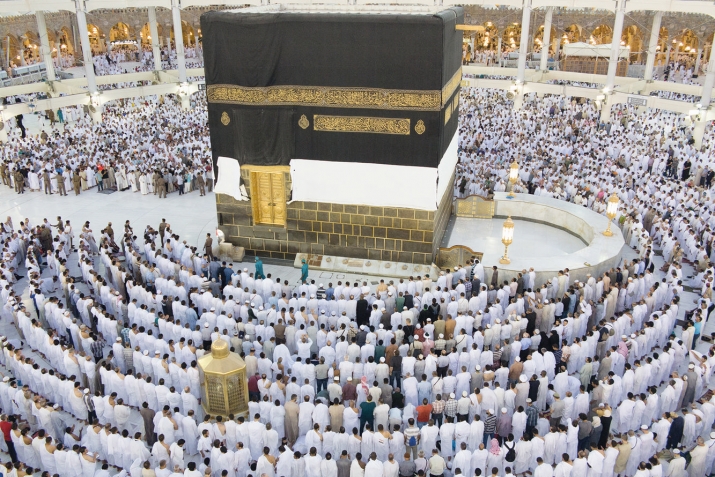
Every year believers around the world undertake the Hajj (pilgrimage) to visit the highly revered Kaaba (the holiest site in Islam) and perform various prescribed rituals.
A hadith of the Prophet ﷺ states: “O people, Allah has made Hajj obligatory upon you, so perform it. Whoever performs it sincerely, without swearing or sinning, is purified of his sins, becoming as if he were born. Umrah (small pilgrimage) is an atonement for sins committed before the next Umrah. And the reward for an accepted Hajj is Paradise.” (Narrated by Ahmad).
Hajj is of great importance for every believer, both in this world and in the hereafter. Hajj cultivates generosity, helps one feel the equality of all slaves before the One Lord, reminds the person of the Day of Judgment and strengthens the bonds of brotherhood. Hajj reminds us of the history of the previous prophets and their followers and provides the opportunity to visit many holy sites.
A hadith from the Messenger of God ﷺ states that whoever leaves his home for the purpose of Hajj or Umrah and dies en route will receive a reward equal to the Hajj as recompense every year until the Day of Judgment.
Hajj is a universal act of worship, as it is performed with both wealth and body. It differs from other pillars of faith in that it is performed only at a specific time and in a specific place on earth, whereas other forms of worship: prayer, fasting, and zakat – can be performed anywhere in the world.
The Importance of Pilgrimage for Believers
Religion places particular emphasis on warm, friendly relationships between people. Its precepts foster unity and solidarity among all believers. For example, residents of a single neighborhood meet five times a day at the nearest mosque, performing daily congregational prayers. Men from an entire community gather in the main mosque once a week for Friday prayers. And all believers on the planet have the opportunity to meet once a year during the Hajj.
During the pilgrimage, all people, regardless of race or nationality, perform the same rites and rituals, addressing their prayers to the One Lord.
The Hajj rituals exclude all privileges: master and servant, minister and worker – all are on the same level, dressed in the same attire. Truly, this is a place that reminds us of the equality of all people before the Creator.
The Hajj is a reminder of the Day of Judgment, when everyone will stand before God in fear of interrogation, where neither nobility of birth, nor wealth, nor social status will avail, except for sincere good deeds.
The Hajj is a reminder of the prophets who came before
Each site where the Hajj rites are performed is associated with a historical event. This allows believers to be fully inspired and to feel a connection throughout the centuries with the image and habitat of the first man, the Prophet Adam. He, as we know, walked barefoot, covered only by a cloak. Before the Kaaba, pilgrims imagine the characters of God’s messengers: Ibrahim (Abraham) and his son Ismail, who rebuilt the Kaaba after the Flood.
Furthermore, believers imagine the Prophet Muhammad ﷺ, who assisted in the restoration of the Kaaba, circumambulated it, and kissed the sacred al-Hajar al-Aswad stone. The hills of Safa and Marwah remind pilgrims of Hajar (the wife of Ibrahim, the mother of Ismail, and the biblical Hagar), who sought water for her son.
While in the valley of Mina, where pebbles are thrown, pilgrims also remember the Prophet Ibrahim, who drove away Satan at this place by throwing stones at him, and the Prophet Ismail, whom his father led to be sacrificed. God gave him a ram in exchange for his determination and fortitude in the ordeal. This ritual has been preserved to this day, with hundreds of thousands of believers around the world sacrificing animals, distributing their meat as alms to all those in need. Standing in the valley of Arafah recalls the first meeting of our forefathers Adam and Eve, which is why some sources call it the Valley of Meetings and Expectations.
It is impossible to describe all the feelings that overcome believers performing the Hajj. Each person must experience them firsthand, undergoing all these rituals, performing one of the most important acts of worship in Islam.