

The Jameh mosque of Isfahan
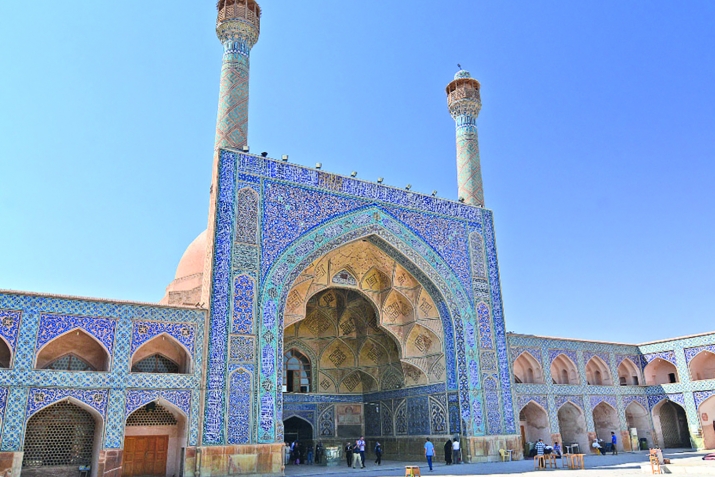
The Jameh Mosque of Isfahan, Iran, is a veritable museum of Islamic architecture and still a working mosque. Within a couple of hours you can see and compare 800 years of Islamic design, with each example near to the pinnacle of its age. The range is quite stunning: from the geometric elegance of the Seljuks, through to the Mongol period and on to the refinements of the more baroque Safavid style.
It is the grand, congregational mosque of Isfahan province and can is a stunning illustration of the evolution of mosque architecture over twelve centuries. The mosque is the result of continual construction, reconstruction, additions and renovations on the site from around 771 to the end of the 20th century. The origins of this mosque lie in the 8th century although this building is thought to have been burnt to the ground leaving only some of the south and north prayer halls intact.
It was rebuilt in the 11th century and went through remodeling many times. As a result it has rooms built in different architectural styles and represents a condensed history of the Iranian Architecture. Spanning more than 20,000 square feet, it is one of the oldest mosques still standing in Iran and was built in the four-prayer hall architectural style, with four iwans placed face to face.
Responding to functional needs of the space, political ambition, religious developments, and changes in taste, further additions and modifications took place incorporating elements from the Mongols, Muzzafarids, Timurids and Safavids.
There is an elaborately carved stucco mihrab commissioned in 1310 by the Mongol ruler Oljaytu, located in a side prayer hall built within the western arcade. Safavid intervention was largely decorative, with the addition of niche-like cells, glazed tile work, and minarets flanking the south prayer hall. The harmony of the brickwork and the later tile work, as well as the plaster mouldings, inscriptions, and other decorations in a setting of glorious simplicity engulf the beholder in an almost spiritual aura.
The mosque has eight entrances, each of them built in a different period, the oldest on its northeastern side now blocked. Its current main entrance is located on its southeastern side. All the buildings are set round a fine rectangular central courtyard leading to a prayer hall on each side of it. The main courtyard spans 60 by 70 metres and contains two pools, one of them partially covered by a platform raised on top of four columns which in the past had been used as a lectern.
Construction under the Seljuks included the addition of two brick domed chambers for which the mosque is renowned. Its doubleshelled ribbed domes represent an architectural innovation that inspired builders throughout the region. The south dome was built in 1086–87 and was larger than any dome known at its time. Inside the dome has been adorned with Mongol-era stalactite mouldings and two minarets.
The north dome was constructed a year later as a direct riposte to the earlier south dome, and successfully so, claiming its place as a masterpiece in Persian architecture for its structural clarity and geometric balance. Inside it is filled with massive cursive Quranic inscriptions. Prayer halls were also added in stages under the Seljuks, giving the mosque its current four-prayer hall form, a type which subsequently became prevalent in Iran and Central Asia.
The prayer hall facing Mecca on the southern side of the mosque was vaulted with niche-like cells during the 1300s.
The mosque also contains alabaster lighting systems for prayer rooms below ground, as well as a wooden carved minbar. In 2012 the Jameh Mosque of Isfahan was inscribed on the UNESCO World Heritage list.
SOURCE: AGENCIES