

Why Black? The Mystery of the Kaaba’s Covering
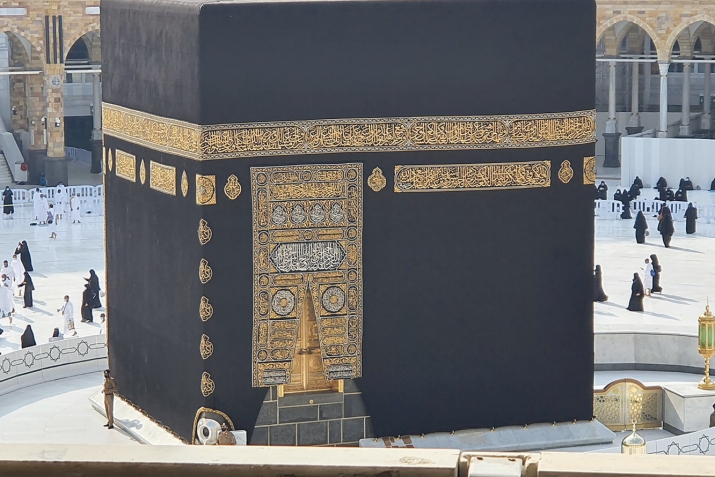
The Kaaba is the focus of all Muslims worldwide during prayer. Every year, millions of pilgrims flock to it to perform the Hajj rites. This cubic structure is the most revered house on earth. Today, the Kaaba is covered with the Kiswah – a black cloth embroidered with verses of the Quran in silver and gold. But has this House of Allah ﷻ always looked this way?
Some sources report that the first person to decorate the Kaaba with a covering was Prophet Ismail, the son of Prophet Ibrahim. Other sources indicate that it was King of Yemen As’ad Abu Karib.
The Prophet Muhammad ﷺ also covered the Kaaba with the Kiswah. From then until today, there has never been a period when the Kaaba remained uncovered. During the Prophet’s time, the Kiswah was a material from Yemen with white and red stripes. During that period, as well as during the reign of the Rightly Guided Caliphs, the Kiswah was renewed once a year. Mu’awiya ordered that the Kiswah be changed twice a year. Under Caliph al-Ma’mun, the Kaaba’s covering was changed three times a year: at the onset of the month of Rajab, the Kaaba was adorned with a Kiswah of white gabati fabric, on the 29th day of Ramadan, the covering was changed to red brocade, and before the day of Arafah, the Kaaba was again adorned with red fabric.
Under the Fatimids, the Kiswah was already white, and under Sultan Mahmud Sabuk Tekin, it was yellow.
The black color of the Kaaba’s covering, which has remained to this day, was introduced by the Abbasid Caliph an-Nasir. However, initially, at his direction, the Kiswah was green. The tradition of removing the old coverings is also associated with an-Nasir. Previously, each new Kiswah was placed over the old ones, and the accumulated layers of fabric posed a threat to the walls of the Kaaba.
For several centuries, the Kiswah was made in Egypt from both local materials and those imported from India, Sudan, and Iraq. But in the 20th century, by decree of the first Saudi king, Abd al-Aziz ibn Saud, a special weaving factory was established in Mecca to manufacture the Kaaba’s covering, and from 1927 until today, the Kiswah has been produced there.
The factory employs 240 male weavers, producing two coverings per year, one as a spare.
The total area of the modern Kiswah is 658 square meters and consists of 47 sections, each 14 meters long and 101 cm wide. The fabric is decorated with verses of the Quran embroidered with gold and silver threads. The Kiswah is also embroidered with the 99 names of Allah ﷻ, the words of the Shahada, and the Tasbih, all embroidered in black thread. One Kiswah requires 670 kg of silk and 150 kg of gold and silver for the verses.
According to tradition, a month before the Hajj, a new Kiswah is given to the Al-Shaibi family. After the Kaaba is washed a second time, the old Kiswah is removed and a new one is put on. The Kiswah is wrapped around the Kaaba and secured to its base with copper rings.
The old Kiswah is then given to the custodians of the Kaaba and the Sharif of Mecca. It is cut into pieces and distributed to the believers. It is worth noting that the tradition of cutting the old Kiswah into small pieces and distributing them to pilgrims dates back to the reign of the second Rightly-Guided Caliph, Umar.