

Prophet Isa Spiritual and Educational Centre
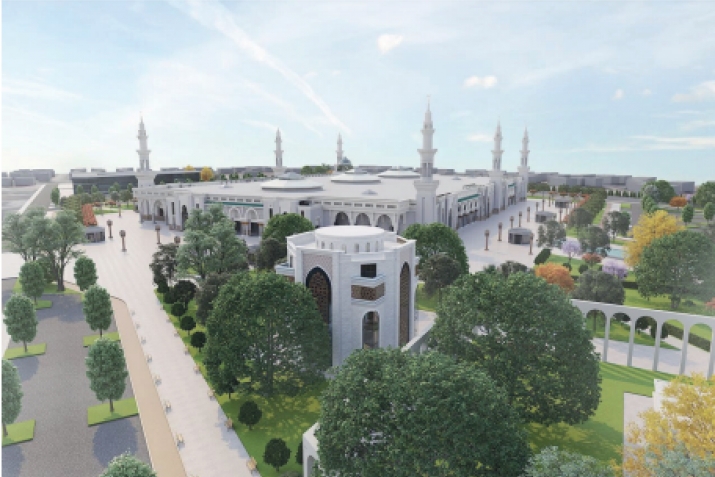
The Spiritual and Educational Centre named after the Prophet Isa was conceived and is becoming day by day a centre for the unification of Dagestanis of different viewpoints, nationalities and confessions under the common banner of cohesion and mutual respect. For this reason, from its very inception the Centre’s motto, “Let's build a spiritual centre together”, has served as a most revealing appeal.
Of course, the jewel in this grandiose plan is the Mosque named after the Prophet Muhammad with its holy relics related to the Prophet e and the history of Islam, as well as a treasured real scale model of the Messenger's house. For this reason many of its architectural and stylistic elements are intertwined with those of the Prophet's Mosque in Medina.
The mosque is a singlestory building, 150m x 200m in plan and 17m high with six minarets and a total area of 32,000 sq.m. Extensive prayer halls for men and women (with a capacity of up to 20,000) are zoned into separate spaces with four fountains, pedestrian areas and dressing room vestibules.
Some cutting-edge design solutions have been necessitated, among other things, by safety requirements; thus all measures prescribed by Russia's Ministry of Construction’s Special Technical Conditions (STC) for fire safety have been strictly observed.
Similar ground breaking STCs have been developed for seismic safety, despite the fact that the construction site is located in an 8 point seismicity zone. The earthquakeresistant building is designed to withstand maximum earthquake motions based on simulated seismic accelerograms (models) of seismic vibrations.
With the aim of preserving as much environmental space as possible, all lavatories and ablution rooms will be located underground and provided with transition points to elevators which will transfer people with special needs directly into the mosque building.
It is also pertinent to consider another “avantgarde project” of the religious complex, which will be a public recreational zone, which together with a more than one kilometre long pedestrian alley from the Caspian seashore to the Spiritual Centre is designed to be motorway cross free. The alley covers an area of 290,000 sq.m, i.e. 66.5% of the entire zone. There is a state of theart 18m wide underpass with gradual ascent and descent beneath the old Kaspiysk highway; everything has been designed for user convenience and easy access.
Access roadways and parking lots around the Centre will occupy an area of 90,000 sq.m. The rest of the buildings are conceived to be of both religious and social functionality: Muftiyat, Graduate School, Rehabilitation Centre, Hotel, Sports Complex, School, Kindergarten and child development centres.
Source: Islam.ru