

Top five great cities of the Great Silk Road
People have learned to establish trade relations since ancient times. The exchange of goods and services allowed humanity to manage its time and property more efficiently.
By developing trade, people learned to transport various goods from one region to another. Thus, goods produced in one area were sold even in the most remote cities.
Just like today, logistics played a special role in trade in ancient times. Trade routes were important not only in the exchange of goods, but also in the exchange of ideas between different parts of the world. One of the striking examples of this is the Great Silk Road, which connected civilizations and cultures, religions and languages.
The location of a city on the Silk Road alone brought it development and prosperity. Trade caravans following the Silk Road brought to these cities not only goods but also knowledge, which provided them with technological development.
In this article, let us together take a short historical excursion into the past and get acquainted with some of the important cities of the Great Silk Road.
1. Samarkand
Samarkand, located in the lower valley of the Zeravshan River in Uzbekistan, was one of the important points of the Great Silk Road. Thanks to the Silk Road, Samarkand became known not only as a large trading city but also as a centre of crafts and sciences.
For several centuries, traders from Samarkand travelled with caravans to China. They mainly traded precious metals, spices and clothing. The city reached its peak in trade and economy during the reign of Amir Temur, becoming the capital of his empire in 1370.
Because of the city’s being a favorable location, Amit Timur accorded priority to the construction of shopping arcades at its centre. Thus, he encouraged the development of trade and did everything possible to attract traders from different regions to Samarkand so that it would become an important trade hub.
2. Aleppo
Aleppo (Halab in Arabic) is considered one of the oldest cities not only in this region but also one of the oldest continuously existing and permanently inhabited cities on the planet. For many centuries, Aleppo was a centre of education, science and handicraft production.
Aleppo was located on the Great Silk Road, which passed through Central Asia and Mesopotamia. Like any city that occupied a favourable location on the Silk Road, it grew and became one of the largest in the region.
The area between the eastern coast of the Mediterranean and the Euphrates Valley, where Aleppo is located, has been known as an important trade hub since the second millennium BC. Thanks to this location, Aleppo became one of the most important cities on the Silk Road.
The former commercial and scientific greatness of Aleppo is evidenced by its citadel, its great Juma Mosque and the Aleppo Bazaar, which stretched for 13 kilometres in length. For centuries, this market was the centre of the city’s economic life.
Each part of the huge Aleppo market had its own name, based on the category of trade represented there. To provide respite for traders and travelers, hammams and caravanserais were established within the market area.
3. Mosul
Another important point on the Silk Road was the city of Mosul, located in northern Iraq. According to Muslim historians of the 10th century, Mosul was the centre of the region at that time.
Mosul became the largest trading hub on the Silk Road during the reign of the Abbasids. Being the centre of an important trade crossroad, Mosul experienced significant development in science and crafts. It is from the name of this city that the name of a thin fabric - muslin - comes.
4. Merv
Merv was the most important city in Central Asia, serving as a kind of trade gate to Central Asia. It acquired especially important trade significance in the 9th-10th centuries. From Merv, travelers went to Amul and further to Bukhara and from there to Samarkand.
During the era of the Great Silk Road, camels, horses, silk, gold, jewelry and spices were traded in the markets of Merv. The city itself, which was in a large oasis, was famous for its vast cotton fields and large orchards.
During the reign of the Abbasids, Merv, which had ten libraries, became one of the main centers of Arabic science. The most striking period in the history of Merv is considered to be the middle of the 12th century, when Sultan Sanjar made it the capital of the Seljuk state.
In addition, Merv was a major trading centre with numerous markets, shops of artisans, blacksmiths, jewelers, weavers, merchants and potters. Merv was not only a trading center, but also a religious center with a huge number of mosques and madrassas.
At that time, the textile industry was widely developed in Merv. Its artisans produced silk and cotton fabrics in abundance, which were supplied to different countries along the Silk Road.
5. Bukhara
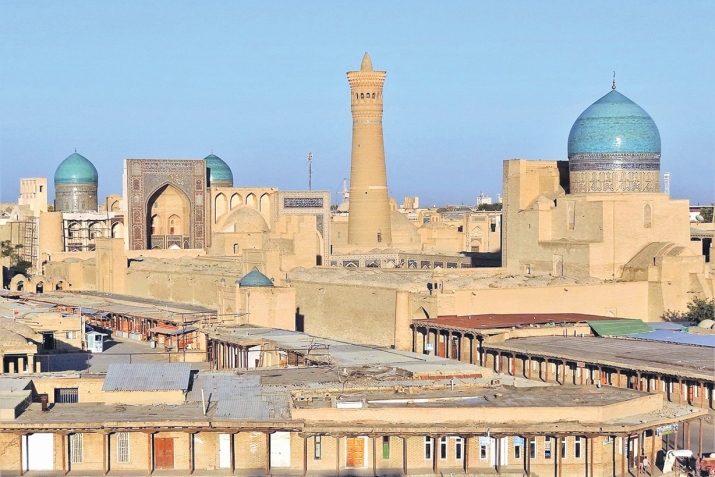
Bukhara is considered one of the most ancient cities of Uzbekistan and all of Central Asia. Being a fertile oasis, Bukhara became a major scientific and cultural center on the Great Silk Road.
For centuries, Bukhara did not change its location and played the role of a major administrative, trade, craft and cultural center of Central Asia. One of the routes of the Great Silk Road, connecting the Mediterranean countries with the Far East, passed through Bukhara.
Due to the fact that Bukhara was located at the crossroads of caravan routes, numerous trading premises and caravanserais were built in the city for the rest of trade caravans and merchants.
The Great Silk Road, which was a network of trade routes that ran through vast territories from China to the Mediterranean, connected not only different countries and cities, but also peoples, cultures, religions and languages, allowing residents of even remote regions to exchange ideas and inventions, strengthening ties with each other.