

Dirham of the Caliph al-Mansur
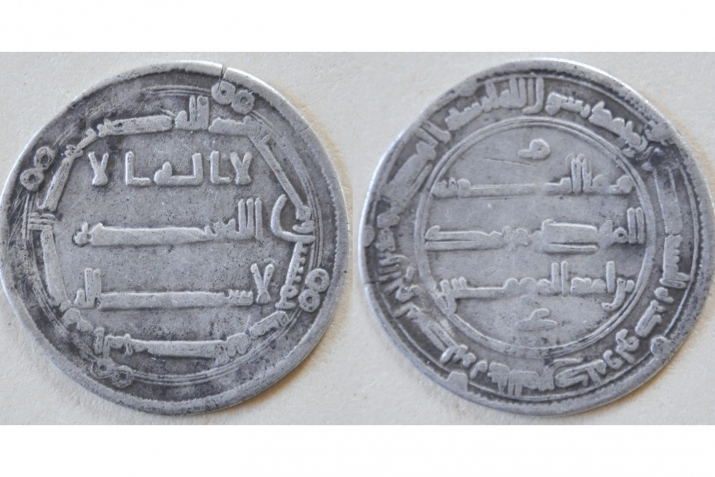
My collection includes a silver Kufic dirham minted during the reign of the Caliph al-Mansur, who ruled from 136 to 158 AH (the Muslim calendar).
The coin was minted in 146 AH at the Kufa mint (now in Iraq) and weighs 2.88 grams.
It was in Kufa that local calligraphers developed a unique script called Kufic. All coins, regardless of the metal they were minted from, that used this script were also called “Kufic”.
This Kufic dirham bears the following text: In the central field is an inscription in three lines (meaning): Muhammad, Messenger of Allah ﷺ (and three dots).
The circular inscription on the reverse side (the so-called “second symbol”) is the 33rd verse (ayah) of Sura At-Tawbah from the Koran (meaning of the commentary): “He (Allah) is the One Who sent His Messenger (Muhammad ﷺ) with guidance and the true religion, to exalt it above all other religions, even if the pagans dislike it.”
In the center of the obverse of this coin is a three-line inscription (meaning): “There is no god but Allah ﷻ, He is one, and there is no equal to Him.”
Circular inscription, issue data (meaning): “In the name of Allah ﷻ, this dirham was minted in al-Kufa in the year 146.”
A description of this coin, number 748, was included in the seminal work “Coins of the Eastern Caliphate”, published in 1873 by the Russian scholar V. Tiesenhausen. Similar coins were called “anonymous” due to the absence of the name of the ruling caliph (ruler) in the text.
Caliph al-Mansur (his throne name translates as “Victorious”) became the second Abbasid caliph after the death of his brother, Caliph al-Saffah.
According to al-Suyuti’s “History of the Caliphs”, al-Mansur was born in 95 AH and lived until 158 AH. He was born into the Abbasid family in Humaymah (modern-day Jordan) after their emigration from the Hejaz in 95 AH. His mother was Sallamah, a slave. Al-Mansur was the brother of al-Saffah. They were both named Abdullah, and to distinguish them, al-Saffah was called by his kunya, Abu al-Abbas. The brothers were great-great-grandsons of Abbas ibn Abd al-Muttalib, the uncle of the Prophet Muhammad ﷺ.
The future caliph, al-Mansur, along with his elder brother, al-Saffah, actively participated in the overthrow of the Umayyad caliphs. Al-Mansur led the rebel army in Mesopotamia during this war.
After assuming power, al-Mansur set about forming a state apparatus capable of implementing the caliph’s policies, collecting taxes, and suppressing rebellions by contenders for power, including those from among the caliph’s close relatives. He established a system of succession to the caliphate that remained in effect for nearly 400 years after his death.
Al-Mansur founded the new capital of the caliphate, the city of Madinat al-Salam (modern-day Baghdad), making it the cultural and scientific center of the Muslim world. He built mosques, libraries, and palaces, attracting the best theologians, scholars, and translators of scholarly works from ancient Greece, India, and the Sassanid Empire.
During his reign, al-Mansur remained mindful of the transience of earthly life and consciously prepared his son, al-Mahdi, for his future leadership. He gained valuable experience as governor of the province of Khorasan, where he collected taxes, built cities, mosques, and caravanserais, managed troops and resolved conflicts.
All subsequent caliphs of the Abbasid dynasty were direct descendants of Caliph al-Mansur.