

Ulugh Beg: ruler and astronomer
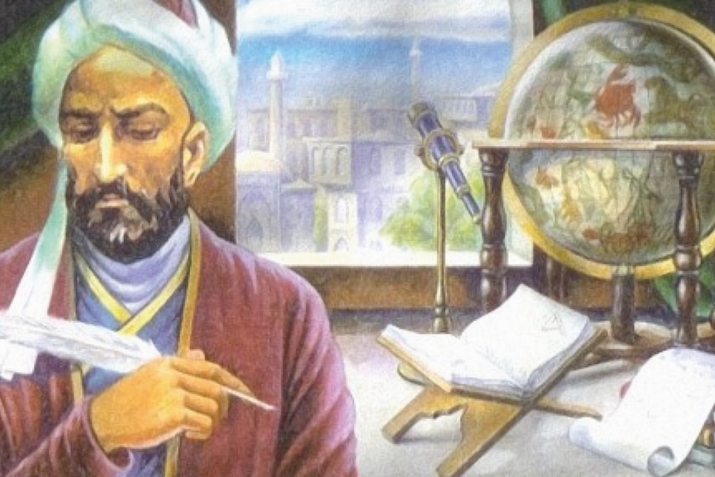
The powerful ruler, Muhammad Taragai ibn Shahrukh ibn Timur Ulugh Beg Guragan (1304–1449), was a great mathematician, astronomer, poet, educator and founder of the ancient Samarkand academy of sciences and the largest observatory of the Middle Ages.
Ulugh Beg was the son of Shahrukh and the grandson of Tamerlane (1336–1405), the powerful military leader who founded the Timurid dynasty in what is now Afghanistan, Iran, Mesopotamia, Northern India and Central Asia.
What kind of person would Tamerlane’s grandson become, so carefully raised by his legendary grandfather and his beloved wife, Saray-mulk-khanum? A warrior, of course! The boy was born during the assault on the fortress of Mardin. Tamerlane always took his family with him when he went on campaign. In honour of his grandson’s birth, Tamerlane pardoned the inhabitants of the rebellious fortress and ordered the soldiers to return their spoils. The child was named after Tamerlane’s father – Muhammad Taragai.
Muhammad Taragai’s mother was an aristocrat from the Turkic Qishlyq tribe, Gauharshad-begim. It was she who instilled in her son a love of science and art. Under her, the renowned city of Herat began to flourish.
Muhammad Taragai always followed his grandfather on campaigns, and was taught the saddle and sword early on. By the age of three, he had already visited India and at five, Asia Minor and Syria. It was during this campaign that Muhammad Taragai became acquainted with the ruins of Nasir ad-Din at-Tusi’s renowned Maragha observatory in the city of Maragha. At one time, it housed more than four hundred thousand manuscripts and employed over 100 astronomers.
The grandeur of the observatory and its focus on the boundless starry sky amazed the boy. Fortunately, his studies were not limited to military matters. His grandmother, Saray-mulk-khanum, invited her beloved grandson to be tutored by Arif Azari, a scholar and poet.
Tamerlane, setting out on a campaign in China, did not take his grandson with him, leaving him to govern his eastern territories. To help the sultan mature more quickly, he was married early to a princess from the Genghis Khanate.
Shahrukh conquered Mave-rannahr, a large region north of Khorasan, and appointed 15-year-old Muhammad Taragai (who became known as Ulugh Beg) as its ruler. It is from this time that the story of this remarkable ruler of the city of Samarkand and the surrounding lands, begins.
He constantly cared for the prosperity of the region and the construction of unique buildings. Ulugh Beg enthusiastically built madrasas (institutions of religious learning) in Samarkand, Gijduvan and Bukhara. He ordered an inscription over the entrance to the madrasa in Samarkand, quoting a saying of the Prophet ﷺ, “The pursuit of knowledge is the duty of every Muslim man and woman.’
The Sultan invited the most talented scholars of the time – astronomers and mathematicians to teach students at the madrasa. Samarkand became the most enlightened city in the East. Philosophers and architects, doctors and poets eagerly settled in this city. Using his excellent knowledge of mathematics, Ulugh Beg implemented a reform in 1428 that stabilized the economy of Maverannahr and at the same time, the Samarkand observatory was completed.
Ulugh Beg enthusiastically worked at the observatory alongside prominent astronomers of his era. Over the course of nine years, the ruler and his associates compiled a catalogue of the starry sky – the Gurgan Zij - or Ulugh Beg’s Zij. It included 1,018 stars. At the same time, Samarkand researchers determined the precise length of the Earth’s year down to the minute as well as the precise tilt of the globe’s axis.
Furthermore, after seven years of persistent and painstaking work, Ulugh Beg published the “New Gurgan Astronomical Tables”. This manual made a great impression on European astronomers and was used by European scholars until the 17th century.
Ulugh Beg’s reign lasted 38 years, a period notable for the region’s prosperity and the absence of violent wars.