

Why did Ivan the Terrible made his citizens take an oath on the Koran?
Historians have a very ambiguous attitude towards Tsar Ivan the Terrible (1530-1584). Some call him a tyrant and reproach him for the murder of his son, while others see him as an outstanding statesman under whom the Russian state significantly strengthened and expanded.
Indeed, after the conquest of Kazan and Astrakhan by the tsar, the territory of Russia became larger. And the state included peoples professing Islam (for example, the Tatars), many of whose representatives ended up in the sovereign’s service. All this forced the tsar and his entourage to study Islam and the peoples professing it and then to develop an appropriate state policy towards them.
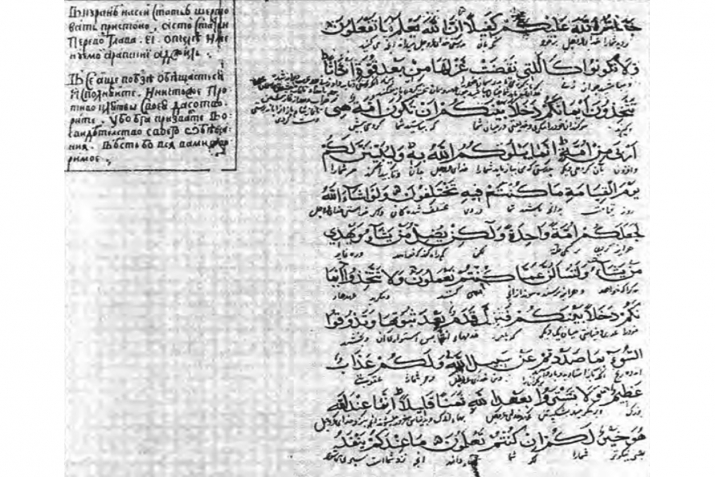
Researcher Rezvan Yefim tells how in the inventory of the archive of the Ambassadorial Prikaz (a modern analogue of the Ministry of Foreign Affairs), compiled in 1560 under Ivan the Terrible, mention is made of “a Tatar Koran, on which the Tatars take an oath”.
The Russian State Archive of Ancient Acts contains one of the copies of these Korans that have survived to this day; it was used to take the oath by Muslims. The most interesting thing is that in this copy of the Holy Book the 91st ayah of the Sura “An-Nakhl” (“Bees”) is written in gold, and next to it there is its translation into Russian in cursive writing of the 17th - early 18th centuries.
The translation of the meaning of this ayah reads as follows (meaning): “Keep the promise to Allah ﷻ that you made. Do not break your oaths after you have sealed them (by swearing by Allah ﷻ), because you have made Allah ﷻ your Guarantor. Indeed, Allah ﷻ knows everything that you do.”
This is, apparently, the earliest extant Russian translation of a fragment of the Koranic text,” writes Rezvan Yefim. The chief bibliographer of the Russian State Library, A.A.Kruming, also writes that in 1570 the clerk Pyotr Grigorievich Sovin took the Koran for an appointment with the sovereign. Thus, Ivan the Terrible had at least a general idea of the Koran and demanded that his Muslim subjects take an oath on a Book sacred to them.