

How to raise a champion?
In studying the life and biography of famous and great people, in most cases, one can see that such persons always have someone behind them, who leads them in life, provides a guideline and fosters the strength of character.
The name of Abdulrashid Sadulaev, nicknamed “Tank”, is known today to almost everyone who is interested in martial arts. He is an Olympic champion, multiple champion of Europe and the world, one of the strongest and most titled freestyle wrestlers of our time, who has the best winning streak among active wrestlers (more than 100 victories with one defeat).
But not everyone knows what and, most importantly, who stands behind such success. I guess, our readers would like to know about the raising of such a champion. We asked the people closest and dearest to Abdulrashid to tell us about his childhood, family and the path he had traveled.
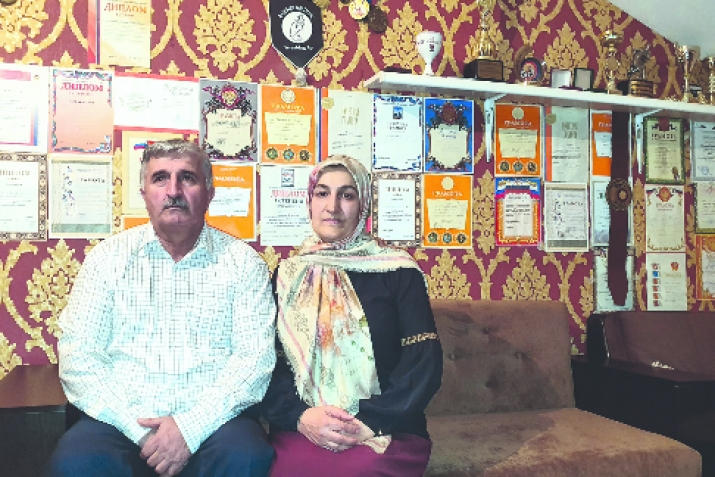
They are his father Bulach Davudmirzaevich and mother Sara Rajabovna, without whom we could not rejoice over the victories of our “Tank”.
- As a rule, behind the achievements of a successful person there are understanding, support and self-sacrifice of loved ones, primarily parents. Please, tell us about yourself and your life.
Bulach Sadulaev:
- I was born on October 2, 1962 in the village of Gilib, Charodinsky district. After graduating from the school I entered the Faculty of General Medicine at the Dagestan Medical Institute. My wife was from Gilib as well. After graduating from the 8th grade she entered the Buinaksk Pedagogical College.
In 1986 we got married and my wife and I were sent to the city of Sverdlovsk (Yekaterinburg). I worked as a doctor in a local hospital and my wife as a primary school teacher. Two years later, I was called up for military service in the city of Kostanay, Republic of Kazakhstan.
There we both pursued the occupations for which we were qualified. In 1991, we returned to our homeland, to the Charodinsky district centre of Tsurib and in 2017 we moved to Makhachkala, where we continued to do the jobs that we love up to this day.
Today I work as a deputy chief physician of the Children’s City Clinical Hospital No. 1 and my wife is a kindergarten teacher.
- Why did you choose this profession?
- You know, my father worked in an ambulance and my mother as a nurse. I frequently visited hospitals. That is why I really liked this profession and I am very happy with my choice.
- Besides Abdulrashid, you have three more children. Tell us about them.
- We have a large family. There are 4 children: 3 boys and a daughter, as well as 8 wonderful granddaughters. The eldest son, Zumrat, was born in Sverdlovsk. He went in for sports as well, and was successful.
When he passed the 5 grade, the Khasavyurt coaches invited him to the Olympic Reserve School, where he achieved good results, but had to leave the sport due to injury. After graduating from college, Zumrat came to Makhachkala, where he entered the institute and later settled there. Today he is the director of the Abdulrashid Sports School.
Our middle son, Anvar, was born in Kazakhstan. He followed in my footsteps and became a doctor. He works in Moscow with his wife in the capital’s medical institutions. Our youngest daughter is Patimat. She, like Abdulrashid, was born in the village of Tsurib. She is in the 9th grade and is an excellent student.
- How and under what circumstances did Abdulrashid go in for sport? Were there athletes in your family?
- Abdulrashid showed an interest in sports, especially in wrestling, from an early age. Therefore, at the age of 7, we sent him to the freestyle wrestling section in Tsurib to the coach Magomed Magomedov. We were friends with him, and had studied together at the Medical Institute as well. It was he who found the inclinations of a future champion in Abdulrashid.
Sadulaev was persistent and hardworking at trainings and had a great desire to develop from an early age. I remember once Magomed said that my son would make a great athlete and suggested to work hard on him. Abdulrashid observed the schedule strictly. He made progress in everything: at home, in school and in training. He was an excellent student and received no bad marks in the certificate.
First on summer holidays, and then after graduating from the school, he went to his older brother, who was then studying in Makhachkala and lived in the suburban village of ShamkhalTermen. From there, Abdulrashid traveled every day, either by taxi or by hitchhiking, to the city to train with Shamil Omarov, who up to this day is his personal trainer.
He did a lot for my son. With every passing year Abdulrashid’s desire to go in for sports only increased. And when the time to choose a profession had come, we had a serious conversation with him. I offered Abdulrashid the opportunity to study as a doctor, but he expressed a desire to practice wrestling professionally. And seeing his strong desire, I agreed.
He went in for big sports. Fortunately, our ancestors on the paternal and maternal lines were strong, healthy and, most importantly, persistent. Apparently, these qualities were passed on to Abdulrashid.
- Were there moments when Abdulrashid wanted to leave professional sports due to injuries or any other reasons?
- Like any professional athlete, he had many injuries as well. Sometimes he got injured just a couple of days before the competition and he had to be cured right then and there. There were also injuries due to which he missed the competition completely.
Each time he scolded himself for perhaps overdoing it somewhere or for being careless in training. Nevertheless he never had an idea to leave the sport because of the injuries or for other reasons, as far as I know. I always tried to support my son in everything I could.
- Do you watch your son's competitions live? How does it feel when your son is performing?
- I always watch his competitions and, as a father, of course, I am very concerned and root for him. At the same time when we watch my son’s matches our relatives and friends often aresurprised at my complete calmness, since they do not see signs of worries about my son on my face.
Well, I just do not show it. My wife goes to another room, she cannot look. She is always worried about everyone. But as soon as it becomes known that our son has won, she comes out and rejoices with us.
- Abdulrashid had only one hurtful loss in his career. Was it hard for him after that?
- We were in the village as usual and everyone gathered to cheer for him. When the fight was over, everyone quietly went home. Of course, there was a bad feeling after that loss, but, as they say, there are no great victories without defeat. It became a new challenge and motivation for Abdulrashid. He called me right after that match and said that he would work hard and show better results. As you know, he succeeded the next year.
- If it was possible to turn everything back, would you decide to go through everything again?
- Yes, I would like my son to go through this difficult path again, as it forms a man into a strong personality.
- With whom does Abdulrashid share his secrets, mom or dad?
- He loves us equally and thus shares his secrets with both us. (Smiles)
- To sum up, please give advice to those parents who want to raise an Olympic champion. Is there any secret?
- First of all, the child must have a purpose in life and a desire to achieve it. He must also have such traits of character as striving, persistence, diligence and patience. And, of course, there must be support from the people around.
I would like to take the opportunity to thank all those who have always supported us. After one of Abdulrashid’s victory of, my phone is literally bursting with calls for several days. All your words of support and wishes only motivate us for further victories.
I thank everyone from the bottom of my heart. You know, for me and my wife, the main qualities in people have always been humanity and kindness. Sports, medals and titles are temporary and changeable things. Therefore, I have the same attitude for all children: to cultivate kindness and responsiveness in them Abdulrashid and never refuse to help anyone.
SHAHBAN SHAHBANOV